Track how narratives move over time
💡 Track how a topic, event, or institution is discussed over time, and spot the pivots as they happen.
The best insight comes from a sequence, not a single question. Trend monitoring means running a fixed set of questions on a regular cadence, keeping the time period consistent so shifts stand out, then varying platforms and asset types to surface where a narrative pivots.
When to use this
When you want to see how discussion around a topic, event, person, or institution changes over time, for example in the run-up to an election or across a long policy debate. Regular monitoring at a steady level of specificity lets you track narrative pivots and identify new narratives and messages as they emerge.
Before you start
Asset. Any account, channel, or outlet Vantage tracks.
Known Asset. An Asset with a documented behavioral track record warranting elevated scrutiny, a designation applied to an existing Asset record, expressed as an Evidence Score of Possible, Probable, or Confirmed.
Reference Asset. An Asset whose identity and operator the client already knows, either because they own it or because they treat it as a known reference point, held outside the classification pipeline so it can serve as a fixed measurement anchor in the Information Landscape.
💡 Tip: Keep the time window identical across runs. A consistent window is what makes a shift visible.
The walkthrough
- Define a fixed set of questions
Choose a small set of specific questions mapped to what you екфсл, and keep them stable so results stay comparable from one run to the next.
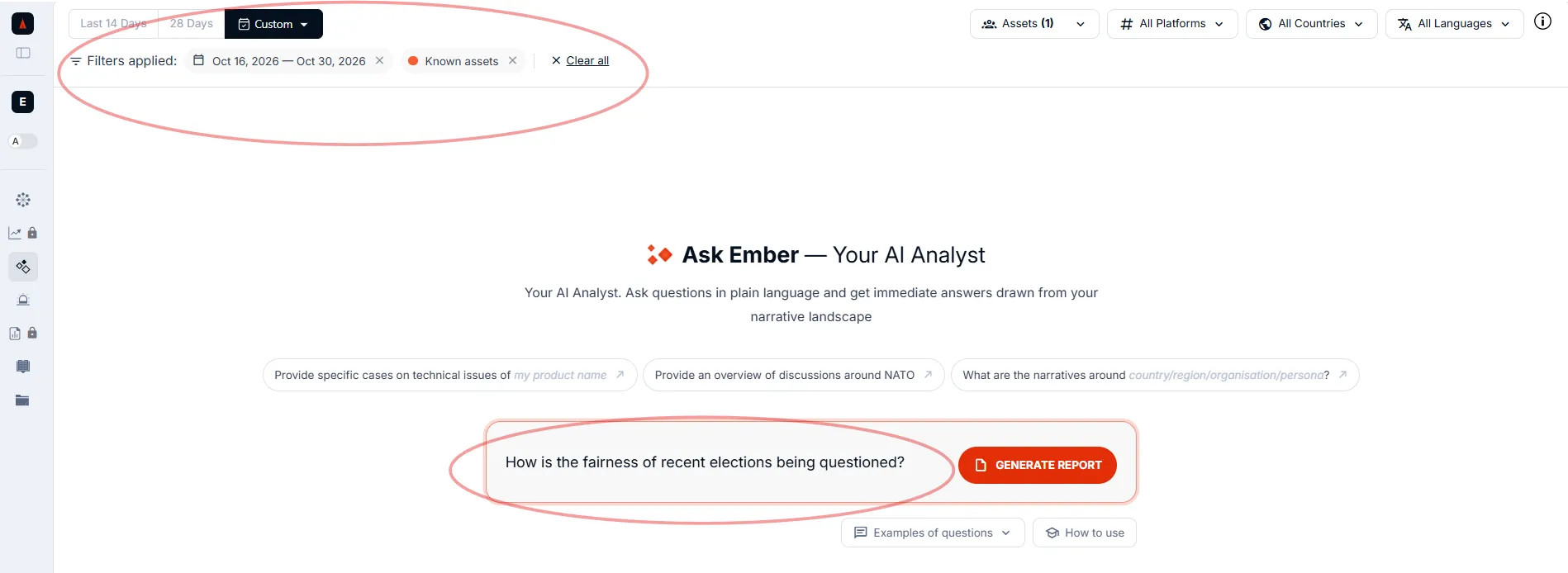
Example questions: What narratives target national electoral authorities? How is the fairness of recent elections being questioned?
- Fix the time window and run on a cadence
Keep the same window each run, for example, the past week, and run the set weekly or bi-weekly. Consistency is what turns a set of reports into a trend line.
- Compare run to run
Reading the same questions over the same period across successive runs surfaces narrative pivots and new messages. The point of the exercise is the comparison, not any single report.
- Vary the filters to find pivots
Once you have a baseline, change one filter at a time: switch platforms, apply Known Assets, or isolate a language, to surface platform-specific or asset-specific movement.
- Share feedback at any point
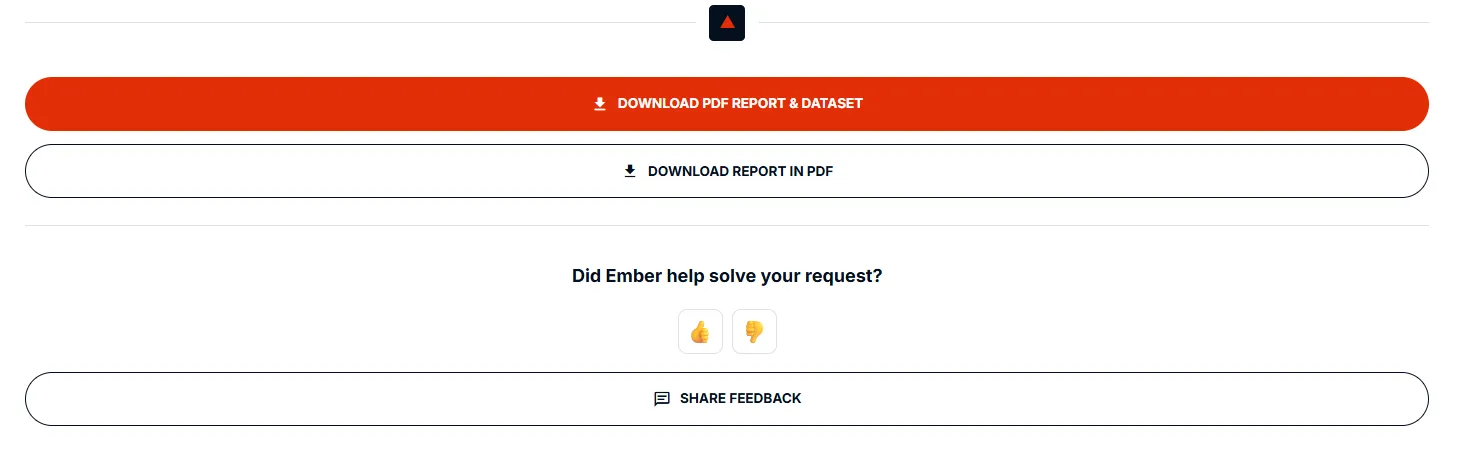
Tell us whenever something is not working or does not look right, or share what would make Ask Ember better for you. At the bottom of every report, rate the result with a thumbs up or down, or use the Share Feedback button to send a note. You can also reach us through the Support button in the bottom-left corner of Vantage at any time.
Have a question? Our team is ready to help via the Support form.
Last Updated: 30 October, 2026